5.5%
OpenRouter's platform fee on credit purchases; 5% on bring-your-own-key usage above a $25,000/mo allowance


Blog
Every article ranking for this search is written by a vendor that lists itself first and hopes you don't notice. We won't pretend to be neutral: we're Unbiased, we make Pareto, and it's on this list. What we will do is put real numbers on the table for everyone, including OpenRouter, and cite where each one comes from.
Skip the read: get a measured recommendation in a few quick questions. Run the Stack Finder
The main OpenRouter alternatives in 2026 are LiteLLM (free, self-hosted), Portkey ($49/month base control plane), Requesty (5% token markup with caching), and Pareto (a blended model with published token rates). OpenRouter itself charges a 5.5% fee on credit purchases and passes token prices through at provider list rates.
TL;DR
OpenRouter's pitch is honest: provider list prices, passed through untouched. The fee sits one level up, on the money you load. A 5.5% platform fee applies to every non-crypto credit purchase (minimum $0.80), 5% flat for crypto, and bring-your-own-key usage is free up to a $25,000 monthly allowance at list-price inference cost, then a 5% fee (enterprise plans carry a $200,000 allowance) (fee breakdown, pricing analysis). There is no subscription and no per-seat cost.
For $100 of credits purchased, the 5.5% fee is $5.50. This is a fee calculation, not a claim that a $100 total charge buys a particular net credit balance. Their basis matters: the 5.5% applies to each credit top-up (minimum $0.80), while BYOK usage is measured in list-price inference dollars, not requests. At $40k a month of LLM spend, about $26k a year for a pass-through on the credit path. Convenience is a real product, but it is worth naming what it costs.
| Fee model | $100 of spend gets you | Who picks the model | Published receipts | |
|---|---|---|---|---|
| OpenRouter | 5.5% on credit top-ups (min $0.80) + 5% BYOK over allowance | list price + fees | you, 400+ catalog | no |
| Requesty | 5% token markup | ~$95.24 of tokens | you, with assists | no |
| Portkey | $49/mo base (100k logs), OSS gateway | $100 provider bill + base/overage | you | no |
| LiteLLM | free, self-hosted | $100 + your ops time | you | no |
| Pareto | models at cost | $100 of at-cost compute | several LLMs per request | yes, public |
Pricing sources: OpenRouter fees · Requesty · Portkey · Pareto receipts on the model card. Checked 2026-07-28.
The column that matters most is the one nobody prices in dollars: who picks the model. Every aggregator hands you a catalog and makes model selection your job, forever, as the catalog changes weekly. Choosing wrong costs more than any platform fee. Pay Fable 5 rates ($10 / $50 per million tokens) on traffic a mid-tier model handles fine and you have lost 10x the aggregator fee before breakfast.
Percentages hide. Dollars do not. Type your monthly LLM spend and see what each option's fee structure costs per year.
Annual fee cost, by monthly spend
| Platform | Fee structure | Fees per year |
|---|---|---|
| LiteLLM | $0, self-hosted | $0 |
| Portkey | $49/mo base (100k logs) | $588 |
| Requesty | 5% token markup | $3,000 |
| OpenRouter | 5.5% on credit top-ups | $3,300 |
Assumptions: one non-crypto credit purchase per month for the entered credit amount, with OpenRouter fee max(5.5% × credits, $0.80); Requesty adds 5% to that amount of list-price inference. Portkey is base-only: $49/month for up to 100k logged requests, then $9 per additional 100k, excluded here. Tokens are billed separately. LiteLLM hosting and operations are excluded. More credit purchases can raise minimum fees. These are fee-basis comparisons, not equal gross budgets or equivalent products. Sources: OpenRouter FAQ, Portkey pricing. Verified September 17, 2026.
Past the crossover? Test the no-fee option with $100, or open this calculator as a standalone tool.
| Monthly spend | OpenRouter, 5.5% | Requesty, 5% | Portkey, base | LiteLLM |
|---|---|---|---|---|
| $100 / mo | $66 / yr | $60 / yr | $588 / yr | $0 |
| $1,000 / mo | $660 / yr | $600 / yr | $588 / yr | $0 |
| $10,000 / mo | $6,600 / yr | $6,000 / yr | $588 / yr | $0 |
| $40,000 / mo | $26,400 / yr | $24,000 / yr | $588 / yr | $0 |
With these base-only assumptions, $49 / 5.5% = $890.91 of monthly credit purchases and $49 / 5% = $980 of monthly list-price inference. Portkey log overages move both thresholds. OpenRouter BYOK is separate: 5% above $25,000/month list-price inference ($200,000 for Enterprise); $49 / 5% + $25,000 = $25,980 before log overages. Pareto is a different product: see its token rates and five benchmark scores, not a gateway-fee comparison.
The standing worry about any gateway is latency: your request makes an extra stop before the GPU. Instead of hand-waving, we measured it on July 28, 2026: twenty streamed requests direct to a provider's API (Anthropic, Haiku 4.5, the fastest tier) versus twenty through a full routing gateway (Pareto, which does strictly more work per request than a pass-through), same tiny prompt, measuring time to first token.
The honest read: the hop is measured in tens of milliseconds, and the variance you already tolerate from providers is bigger than the detour. Latency is a real concern for gateways that add heavy reasoning to routing decisions on hard tasks (we document ours on the model card: up to 3x on the hardest reasoning, +0 on agentic work), not for the network hop itself.
Time-to-first-token, twenty times, one line of shell per run. Swap the URL and key for OpenRouter, Requesty, or anything else, and compare against the provider direct:
for i in {1..20}; do
  curl -s -o /dev/null -w "%{time_starttransfer}\n" \
    https://openrouter.ai/api/v1/chat/completions \
    -H "Authorization: Bearer $KEY" -H "Content-Type: application/json" \
    -d '{"model":"anthropic/claude-haiku-4.5","stream":true,
         "messages":[{"role":"user","content":"Reply with one word: ready."}]}'
done
We have not yet published OpenRouter and Requesty numbers ourselves; when we do, they will appear here with the same method. If you run it first, send us your data and we will link it.
We would rather show you the public record than adjectives.
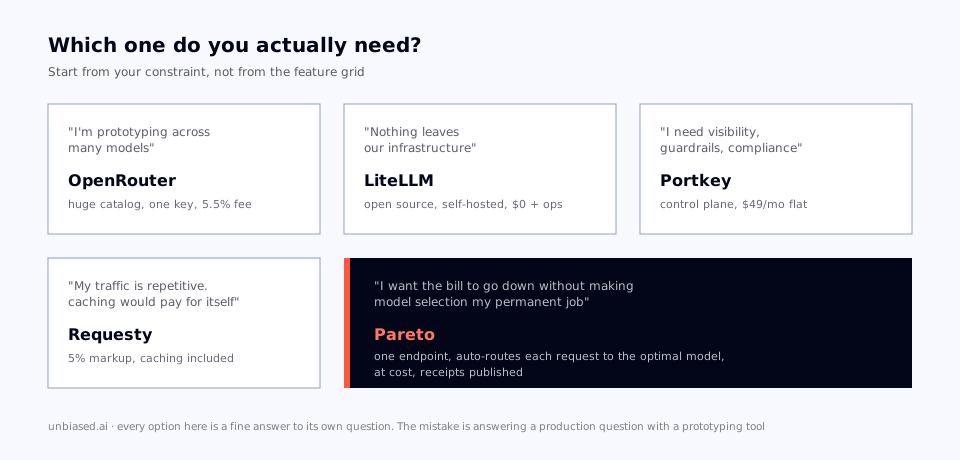
The open-source gateway you run yourself. Zero markup, full control of the data path, one interface to every provider. The cost is operational: it is your infrastructure now, including the 3am part. The right answer when the constraint is "nothing leaves our VPC" and you have the team.
The production control plane: observability, retries, guardrails, logs, compliance. $49 a month flat rather than a percentage, which crosses over quickly. At $10k in one monthly credit purchase, OpenRouter's fee is $550. Portkey's $49 base includes 100k logs; each additional 100k costs $9. The right answer when your problem is visibility, not the bill. TrueFoundry plays a similar role for VPC-deployment enterprises; Eden AI if you need image, video, and audio APIs under one roof.
The lightweight managed option: 5% token markup, caching included, EU data residency on every plan. On repetitive traffic the caching can genuinely offset the fee.
Pareto 26.9’s published benchmark scores are on the model card. Measured task costs and a composite score have not been published for this release.
We ran four everyday production tasks through Pareto on July 28, 2026 and recorded the actual bills. For comparison, the same token counts priced at Claude Opus 4.8 list ($5 in, $25 out per million tokens) and Claude Fable 5 list ($10, $50).
| Task | Tokens in / out | Pareto, actual | @ Opus list | @ Fable list |
|---|---|---|---|---|
| Single-file HTML dashboard | 77 / 2,615 | $0.0164 | $0.0658 | $0.1315 |
| Invoice to structured JSON | 182 / 259 | $0.0018 | $0.0074 | $0.0148 |
| Unit-economics analysis | 84 / 504 | $0.0033 | $0.0130 | $0.0260 |
| Meeting notes to action items | 153 / 229 | $0.0016 | $0.0065 | $0.0130 |
| Four-task total | $0.023 | $0.093 | $0.185 |
Pareto 26.9’s published benchmark scores are on the model card. Measured task costs and a composite score have not been published for this release.
Now stack the fee conversation on top. An aggregator's 5% fee on the $0.093 Opus version of this workload is half a cent. Routing the same work to the right models saved 7 cents, fourteen times the fee. That is the category's open secret: the fee is not the money. The model selection is the money.
Every option on this page, including Pareto, speaks the OpenAI-compatible API surface. That means the migration cost between them is a base URL and a key, and your evaluation can be an afternoon rather than a quarter:
# before: OpenRouter
client = OpenAI(
    base_url="https://openrouter.ai/api/v1",
    api_key=OPENROUTER_KEY,
)

# after: Pareto (or any gateway on this page)
client = OpenAI(
    base_url=PARETO_BASE_URL,  # provided with your credits at onboarding
    api_key=PARETO_API_KEY,
)
The lock-in in this category is not technical. It is the accumulated credits balance and the routing habits you have built. Which is an argument for running a real side-by-side on your own traffic before your balance gets large anywhere.
No. Per OpenRouter's published fee schedule, per-token prices pass through at provider list rates; revenue comes from the 5.5% fee on credit purchases (minimum $0.80, 5% for crypto) and a 5% fee on bring-your-own-key usage above a $25,000 monthly allowance, computed at list-price inference cost (fee breakdown). You pay list plus a load fee, not inflated token prices. One nuance: the same model can be served by multiple providers at different list prices, so which provider serves you affects the rate you pass through to.
People search for one constantly; we have never seen a standing public code. The honest version of the discount is structural: use bring-your-own-key under the free monthly threshold, compare fee bases and included log volumes before choosing a gateway, or stop paying list prices at all.
Two clean answers. Requesty includes EU data residency on every plan, and LiteLLM self-hosted in your own EU region is as resident as it gets. If data locality is a hard requirement, those are the shortlist; verify each provider's current data-flow documentation before committing.
Usually not. The OpenAI-compatible surface is the de facto standard across this category, so leaving is a base-URL swap for most integrations. The exceptions are OpenRouter-specific features like its provider-preference routing parameters, which do not travel.
Answer four questions, get a straight recommendation
Not sure which model fits?
The Stack Finder asks a few quick questions about your workload and gives you a straight recommendation. No account required.
Compare any two models
List rates and dated competitor measurements: prices and measured bills. Pareto 26.9 measured task costs are not published. Verbosity: Edition 2.
Don’t act on this yourself. Hand it to your agent and let it do the switching math for you.
Measured, not marketed
A few quick questions, no account required, one testable stack. Published scores and pricing are available on the model card.
Run the Stack Finder